The Tale of Two Farmers: Broiler vs. Layer Chicks—Which Is More Profitable in Cameroon?

The dusty road leading to Mbouda was filled with the usual chatter of the market day, but for two friends, Donfack and Ngaleu, the conversation was far from ordinary. They stood at a crossroads—literally and financially. Both had exactly three million FCFA to invest. Donfack, always the man in a hurry, wanted his money back before the next rainy season. Ngaleu, patient as a mountain, was looking for a “pension” that would pay him every morning while he sipped his coffee.
Donfack pointed to a crate of eggs. “Ngaleu, you want to wait months for an egg? I want meat, and I want it now!”
Ngaleu smiled, tapping his notebook. “A chicken is eaten once, Donfack. An egg is sold every day. Let’s see whose bank account is heavier by December.”
This is the heartbeat of the Cameroonian poultry industry. Every year, thousands of farmers ask the same question: Broiler farming vs. layer farming—which is profitable enough to change my life? As a veteran with 18 years in this industry, I have seen Donfack thrive, and Ngaleu build empires. But the truth isn’t in the bird; it’s in the strategy. Are you a sprinter or a marathon runner?
The “What” and “Where”: Understanding the Cameroonian Poultry Landscape
In Cameroon, the demand for animal protein is skyrocketing. Whether it’s the “Poulet DG” served in the sleek restaurants of Bastos, Yaoundé, or the hard-boiled eggs sold at the bus stops in Akwa, Douala, the market is hungry.
Broiler farming involves raising birds specifically for meat. These are high-performance athletes like the Hubbard or Cobb 500, designed to grow at a blistering pace.
Layer farming, on the other hand, is the art of raising birds to produce table eggs. These birds, such as the ISA Brown, require a delicate touch and a long-term commitment.
But where do you start? If you are in a high-density urban area like Douala, the turnover for meat is lightning-fast. If you are in a more rural setting where transport is a challenge, eggs—which have a longer shelf life without refrigeration—might be your king.
Have you looked at your local market lately? Is the “Mama” at the corner screaming for more meat, or are the local shops constantly out of egg crates?
Why the Choice of a Quality Chicks Supplier is Your Secret Weapon
Whether you follow Donfack’s path or Ngaleu’s, there is one non-negotiable rule: You cannot harvest gold from lead.
Many farmers in Cameroon make the mistake of buying “cheap” chicks from unlicensed hatcheries. Donfack learned this the hard way during his first trial. He bought 500 broiler chicks from an unlicensed hatchery. By week three, 100 were dead, and the survivors looked like sparrows rather than chickens. He saved 50 FCFA per chick but lost 400,000 FCFA in potential meat.
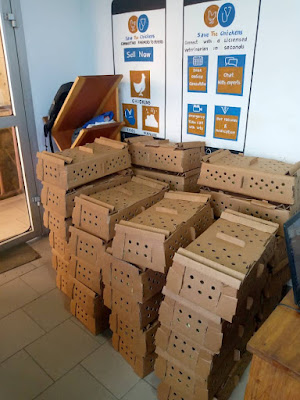
At Poultry Farmers Management Systems (PFMS Hatchery), we believe a chick is a promise. Our hatchery uses precision incubation technology to ensure that every day-old chick has:
- A robust immune system.
- The genetic potential to hit target weights.
- The resilience to thrive in the Cameroonian climate.
Ask yourself: Is saving a few francs today worth risking your entire capital tomorrow?
Scenario 1: Donfack and the 45-Day Broiler Sprint
Let’s look at Donfack’s strategy. He decided to dive headfirst into broiler farming. He understood that in the poultry world, time is money.
The “How” of Broiler Profitability:
Donfack built a standard poultry house and focused on biosecurity. He bought 1,000 broiler chicks from PFMS.
- Day 1 to 21: He focused on heat and high-protein starter mash.
- Day 45: His birds averaged 2.9 kg.
- The Sale: He sold the entire batch to a hotel and restaurant chain in Douala.
Because he turned his money over in less than two months, he was able to run six cycles in one year. By the end of the year, Donfack had handled more cash than he ever thought possible.
Use Case Scenario: If you are a farmer with limited space and need quick cash flow to pay school fees or reinvest in other businesses, broiler farming is your best friend. It’s high intensity, high reward, and low duration.
Scenario 2: Ngaleu and the Layer Farming Marathon
Now, consider Ngaleu. He looked at the same 3 million FCFA and chose layer farming.
The “How” of Layer Profitability:
Ngaleu knew he wouldn’t see a single franc for at least 18 weeks. He spent his money on high-quality pullet developer feed and followed the PFMS vaccination schedule to the letter.
- Month 5: The first “jumbo” eggs appeared.
- Month 8: His flock was at 92% production (920 eggs from 1,000 birds every day).
- The “Salary”: Every morning, a wholesaler came to his gate in Mbouda and handed him cash for 30 crates of eggs.
While Donfack was stressing about finding new buyers for every batch, Ngaleu had a steady, predictable income that lasted for 16 months straight. At the end of the cycle, he sold his “spent layers” as meat, which provided the capital for his next batch of chicks.
Use Case Scenario: If you are looking for long-term stability and a “daily salary” to build a permanent estate, layer farming is the winner. It requires more patience and higher initial capital, but it offers the most consistent profitable returns over time.
How to Maximize Profit: The Expert View
In my 18 years of experience, I’ve realized that profitability isn’t just about the bird; it’s about the management system. Whether you are raising broilers or layers, you must master the “Big Three”:
- Feed Conversion Ratio (FCR): In broiler farming, if your birds eat 2 kg of feed but only gain 1 kg of weight, you are losing money. Quality genetics from a leader like PFMS ensures your FCR is optimized.
- Biosecurity: Disease doesn’t care about your dreams. A single visitor with dirty boots can wipe out Ngaleu’s 18-week investment in 48 hours.
- Market Timing: Donfack makes the most money when he times his broiler harvests for Christmas, Easter, or the 11th of February. Ngaleu makes his money by maintaining high production during the “lean months” when egg prices spike.
Which farmer are you? Are you prepared for the 45-day adrenaline rush or the 21-month steady climb?
The Final Verdict: Which is More Profitable?
In the Cameroonian context, broiler farming is more profitable for the “Cash-and-Carry” entrepreneur who can manage high risks. Layer farming is more profitable for the “Wealth-Builder” who wants a sustainable, long-term business model.
However, the most successful farmers I know—the ones who have become leaders in the industry—often do both. They use the quick profits from broilers to fund the expensive feeding phase of their layers.
Why Partner with Poultry Farmers Management Systems (PFMS)?
Success in poultry is a team sport. At PFMS, we don’t just sell you a box of chicks and wish you luck. We provide:
- High-Intent Genetics: Chicks that are bred to perform, not just survive.
- Expert Farm Management Consultation: Access to 18+ years of experience to help you troubleshoot your ventilation, feeding, and health protocols.
- Full Value Chain Support: From the hatchery to the market, we help you navigate the complexities of the Cameroonian industry.
Are you ready to stop guessing and start earning? Donfack and Ngaleu both succeeded because they stopped buying “random” chicks and started using a system.
Start Your Journey Today!
Don’t let your capital go to waste on poor genetics. Connect with Poultry Farmers Management Systems (PFMS Hatchery) today and secure the best day-old chicks in Cameroon.
- Call/WhatsApp our Expert Consultants: +237 675 33 52 52 / +237 655 65 80 12
- Visit our Office: En Face Carrefour Market Bonaberi Douala, Cameroon.
- Email us for a custom farm. Plan: info@pfms.cm
PFMS: Empowering the Cameroonian Farmer, One Chick at a Time.


Comments
Post a Comment